“In the Distance” by Hernán Diaz
Short Summary:
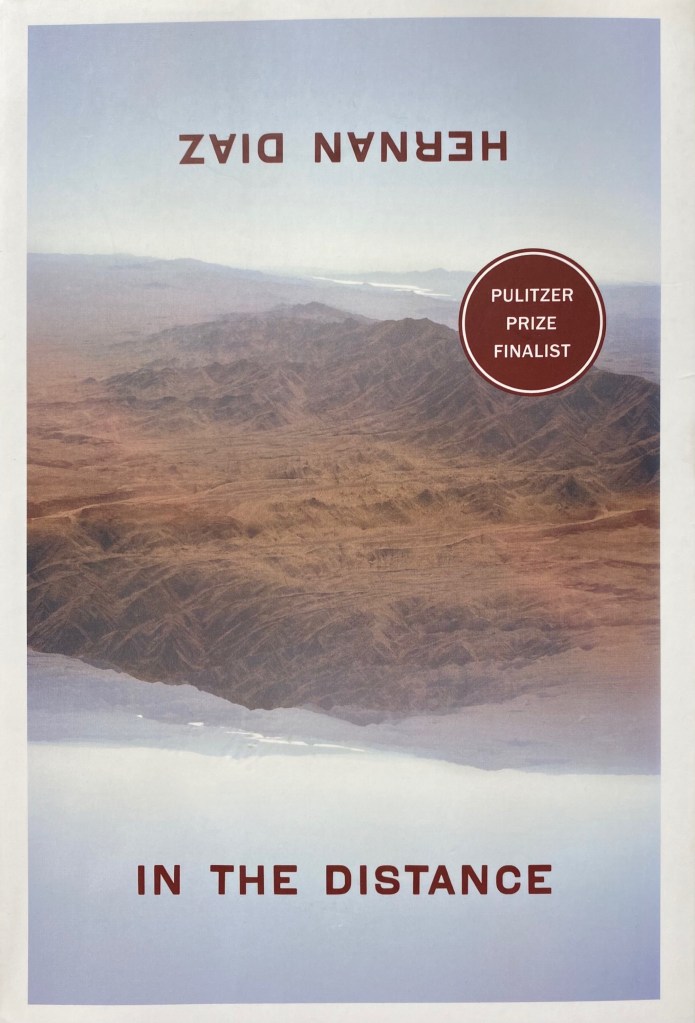
This novel, by author Hernán Diaz, was a Pulitzer Prize Finalist. The story takes place in 19th century America and follows a young Swedish boy- Håkan Söderström – and his older brother, Linus. Sent to New York by their parents (in hopes of a better life) they separate and Håkan ends up on a schooner headed for San Francisco. What follows is the story of Håkan’s journey of traveling to New York to find his brother.
This story begins in a chilling and foggy frame narrative that depicts a much older Håkan- who is known only as “The Hawk” or “Hawk”- as he emerges from an icy lake. He then retreats to the iced-in ship that he was traveling on and tells the story of his life to the crew he is stranded with. His story begins in Sweden but soon the reader is engulfed in the desolate and violent nature of the American West. Not knowing any English, the young boy has a shocking and, often, disturbing coming-of-age storyline that will poetically exemplify the harshness of Frontier life.
Håkan is considered an outcast: feared and shunned by some, while accepted and revered by others. He learns language, philosophies, survival skills, and more as he attempts to find his way east. He is taken in by several well-rounded and unique characters, such as a Naturalist, Criminals, Native Americans, Lawmen, and more. The more he attempts to understand both the natural world and human nature, the more his legend grows. Soon, everybody and nobody knows him. This is a beautiful story full of flawless prose. A fresh new take on an often romanticized era of American History.
My Review:
Diaz does an incredible job writing a Swedish Immigrant’s experience in the American West during the 1800’s. There is a certain sense of fear that the reader gets when they embark on this journey with Håkan, who arrives not knowing any English, let alone where in the country he is or what this country looks like. There is hardly any Dialogue in the beginning of the novel because the third-person narrator wants the reader to sense that unfamiliarity/terror that Håkan feels in the territories. Rather, there are these moments where the narrator attempts to make sense of a scene through Håkan’s childish gaze, often using gestures and tones to describe something he can not understand. For example:
Then, as if a spring activating a hidden mechanism had been set off, [the fat man] smiled, took a small bow, and, quite loudly, addressed the strangers. It seemed to be a formal speech. While talking, the fat man described an arc with his upturned hand, encompassing the whole bar or maybe even the entire desert beyond it…” (Diaz 25)
Meanwhile there are these incredible descriptions of the landscape and the people that occupy it. Diaz captures the vastness and wildness of territorial America, all while moving the character’s through heart-wrenching situations. There are obscurities and oddities riddled throughout this book as well. The cast of characters are all so developed and unique that you have little to no issue believing the strangeness of this story.
Håkan is a protagonist out of some ancient mythos, reminiscent of Judge Holden in Blood Meridian . An innocent boy that grows into a giant of a man. His stature often intimidates the other men and women of the book and only adds to his lore, a lore that is exaggerated with each passing homesteader or traveler. As Håkan makes his way east he is confronted with several threatening scenarios: sickness, injury, isolation, the relentless desert, criminals, and the law. Scared of the wildness of the territories to the west and the unjust society that slowly approaches to the east, Håkan decides to isolate himself, believing that his only option is to live out his life as a recluse.
There are so many aspects of this novel that I can praise or discuss, but I wanted to touch on the historical accuracy of Diaz’s writing. Not only is his depiction of a young, Swedish boy in an unknown America just fascinating, but he accomplished such a vivid depiction of the west in the 19th century. He is able to place the reader in this era with ease, while not bending to the tropes and clichés of the western genre.
RAAW (Reading as a Writer):
What I would like to discuss in this section of the review is the theme of confinement in this novel. Diaz captures the essence of this theme in several ways, including both physical (or metaphysical) and psychological experiences. The story starts out with a Frame Narrative that includes several images depicting confinement: Breaking through a ceiling of ice, the ship being stuck due to the weather, etc. Then of course, there is the main narrative where we see the language barrier create a sense of confinement or isolation for Håkan. He is longing to find his brother but cannot tell anyone of his suffering, unfortunately confined to his own thoughts.
Later, we see nature affect Håkan. First, as he is wandering through the desert, he loses his sense of direction and believes that he is walking in circles. This is an example of psychological confinement. Like Sisyphus, he makes his way to the edge of a bluff, only to find that he has returned to where he started (or so he believes)
The sameness of the landscape only added to his derangement. He came in and out of consciousness and found himself in midstride, marching through a country identical to the one he had seen before his spell. It was impossible to know how much time had elapsed or how far he had traveled. Sometimes he thought he was walking in place.” (Diaz 54)
In a way, it creates a certain disorientation for the reader as well. This confusion or disconnect is something that Diaz is trying to accomplish. And it goes beyond the written story! In an interview at Pasadena Public Library, Diaz even describes the significance of the cover having his name upside down. He says, “The cover tries to mimic the disorientation that is at the core of this book. It’s a book about being lost. So, I was hoping that people would be confused by the cover…” (See the Interview, One City, One Story Here) He actually wants the reader to have a physical reaction to the cover, where they have to turn it to read his name… Little do they know, they have already been disoriented by the book.
I don’t want to spoil anything for my followers, but the idea of casting himself out (or self-confinement) is abundant in this book. Håkan wants to spend his life away from people…. and he does spend a lot of time in small spaces, hidden from the rest of the world. Places such as caves, burrows, locked hotel rooms, stagecoaches, and the bottom of ships. Surely, Diaz included these motifs for a reason, and the result is a dreadfully isolated and extremely emotional plot.
In Conclusion, I think that this book is worthy of its Pulitzer recognition. The prose is beautiful and the characters are incredibly unique. This novel will have you laughing, crying, and jumping at every turn of the page. Highly recommended! You will definitely enjoy this book if you liked:
- Butcher’s Crossing by John Williams
- Blood Meridian by Cormac McCarthy
- A Prayer for the Dying by Stewart O’nan

 OSCAR H. WHITE
Leave a comment