“Monsieur Pain” by Roberto Bolaño
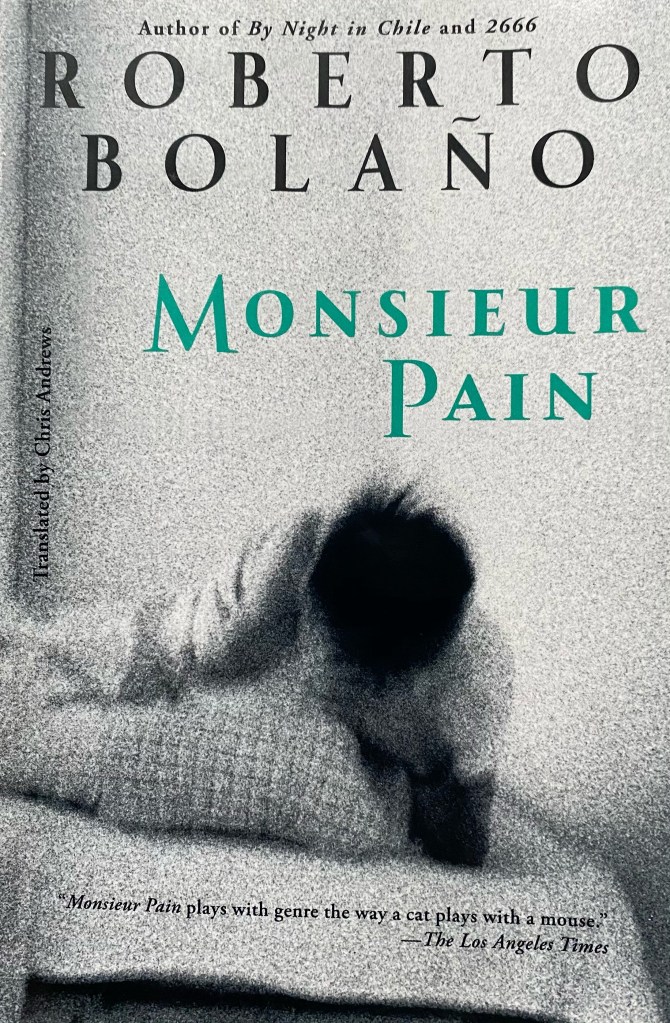
Short Summary:
This novella, by the late Chilean Novelist Roberto Bolaño (author of 2666 and Distant Star), is a dark and mysterious thriller that bends the rules of storytelling. A truly remarkable work of fiction that challenges the reader and their ability to understand both the atmosphere of the book and its characters.
The story begins from the perspective of Pierre Pain, a mesmerist that practices in occult science, as he works and lives in France. It is 1938 and Monsieur Pain is asked to see the Peruvian Poet, César Vallejo, who is dying in a Parisian hospital. After meeting the poet and his family, he realizes that he is being followed by two unidentified Spaniards. When confronted, the men offer him a bribe of 2,000 francs. Pain believes they are working for Francisco Franco, the Spanish General, as the Spanish Civil War (1936-1939) lumbers on. The bribe is to get him to stop visiting and treating Vallejo. He accepts the bribe, but when he returns to the hospital, in attempt to speak to Vallejo, he is turned away.
What comes next is a maze of hallucinatory scenes, as Pain wanders the timeless streets of Paris. He is pressured by political threats, an obsession of forbidden lust, and professional anxieties. Pain visits the strangest and dimmest corners of Paris at night (Bars, Cafes, gambling rooms, stairwells, etc.) This journey ultimately ends with him sleeping in a warehouse where he is visited in the darkness by a hidden apparition of Vallejo, or so he believes. The novel ends as Pain sees one of the Spaniards walking the streets of Paris. He follows him into a movie theater and learns that he works for a former colleague and occult practitioner. Frustrated, Pain returns to the hospital and finds that Vallejo has disappeared.
Genres: Psychological Fiction, Surrealism, Chilean Literature, Paranormal
My Review:
I have always been a fan of Bolaño and the tension that he creates in his stories. The unbearable mystery and/or ambiguity that define (or loosely define) his characters is mesmerizing. I question the reliability of the narrator and the truths of his reality for the entire novella which is what drives a reader to turn the page. Directly related to the tension of the story, are the stakes of the characters. There is a lot at stake for Pain as he deals with his professional career, his political beliefs, and his love for one of the secondary characters. This drives him into an anxiety induced trance as he travels the streets, exploring the strange and erotic secrets of Paris at midnight.
It is a mystery that– without ruining the book for its readers– is left open for interpretation. Vallejo is pronounced dead at the end of the novel leaving Pain and the reader speculating. This is something that isn’t necessarily found in the genre of mystery–whether it be film, theater, or literature. In other words, leaving questions unanswered can sometimes contribute to the literary value of the book. To me, toying with the classic genre tropes is an act of authorial genius.
Bolaño’s language is a stand-out in this novella as well. The descriptions of setting are great, the dialogue is great, and the voice is great. Bolaño creates a narrator that is both intelligent and philosophical in his daily thinking, and places Pain in absurd and ludicrous situations that stretch him to his existential limits. In other words, I just wanted more and more… I read the book– which is only 130-135 pages in length — in just one evening, and I plan to re-read it in an attempt to better understand his craft.
What also intrigued me about this novella was the geographic and political influences. It reminded me of Kundera’s The Unbearable Lightness of Being. Pain is being driven by both professional and political stresses, much like Tomáš in Kundera’s novel, who is a Czech surgeon during Prague Spring in 1968. The ominous feeling of political influence is evident in Pain’s narrative as well with the storyline of both the Spanish Civil war and the influence of Vallejo’s poetics. If you enjoy Kundera’s work, this book may interest you.
RAAW (Reading as a Writer):
When I read this Novella, I couldn’t help but notice the voice of Pain’s interior narrative. Told in the first person, it is a close examination of Pain’s psyche, especially when things become blurred. In fact, it is this intrigue in the protagonists psyche that made me examine these moments of disorientation with microscopic precision. I want to understand where he is and who he is interacting with… but Bolaño does not allow it. The middle of this novella is meant to separate the reader from the narration which, ultimately, is the goal of surrealism. Ursula K. Le Guin, who was a wonderful writer and literary figure, wrote in her review of the book:
“Surrealist narrative is a literary form at war with itself; disconnection is a primary tactic of surrealism, and story is a process of making connections, however unexpected.” Ursula K. Le Guin, The Guardian
The disconnection that Le Guin is talking about is key. The reader is supposed to feel lost with the character. If the first person narrator does not understand what is happening, should the reader? This is an aspect of psychological fiction that fascinates me: the reliability of the narrator and the craft elements that make up scenes of disorientation or surrealism. Craft elements such as variation in sentence length, stream of consciousness, playing with the emotional urgency of a character, getting lost in a setting and/or memory, etc.
Why do writers attempt to disconnect their readers? What would be the advantage of that? Well, I believe that these moments of surrealism offer the reader a lot of character development. What precedes and what follows these scenes help define them or, rather, change their character completely. I think that psychological fiction deals much more with the characters psyche than it deals with plot. The genre wants to explore those changes… The author wants you, as the reader, to explore those changes. Perhaps Frankenstein is an early representation of this. Or any of Poe or Lovecraft…
In conclusion: this book is an incredible read. Short and dense… it can be read in an evening but argued and debated for weeks. The writing is splendid and the break away from the mystery genre tropes make it unique, unlike anything I have read… Perhaps the closest genre-defying book I can relate it to is Chronicles of a Death Foretold by GGM. To me, Monsieur Pain is one of the best psychological novels I have read thus far. It wrestles with reality, metaphysics, and existentialism… A journey that is meant for the reader as much as it is meant for Monsieur Pain himself.
More by Bolaño:
- “2666” (2004)
- “Distant Star” (1996)
 OSCAR H. WHITE
Leave a comment