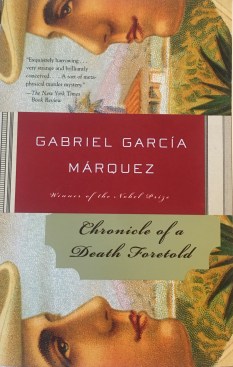
“Chronicle of a Death Foretold” by Gabriel García Márquez
Short Summary:
Gabriel García Márquez, the brilliant Colombian-born author who brought us One Hundred years of Solitude and Love in the time of Cholera, published the short novella entitled Chronicle of a Death Foretold in 1981. A story of honor, culture, love and betrayal.
García Márquez tells a first person account of a murder that has taken place in the small coastal town in Colombia where the narrator grew up. Instead of present tense, it is told from the narrator’s perspective during an investigative return to the town a quarter century later. In an attempt to understand the reasoning behind the murder of Santiago Nasar, a man who was a well-known local, the unnamed narrator turns to the townspeople; who still harbor secrets, guilt, and unrest from nearly 27 years before.
Everybody knew that the man was to be murdered, yet nobody took action to stop it. Why? How could a town, that is so riddled with gossip, not warn the victim in his last moments? The answers all stem from one evening: the night of Angela Vicario and Bayardo San Roman’s wedding. After learning that she has bedded with a man before their marriage, San Roman returns Angela to her childhood home. When asked who she had slept with, she gives one name: Santiago. Quickly her twin brothers take action. From there, the narrator investigates those blue hours of dawn. The Bishop arrives in the morning by boat to bless the marriage. Soon after, a body is found. What happened between the festivities and the gruesome murder of Santiago? Who is to blame?
Genres: Fiction, Mystery, Pseudo Journalism, Novella.
[Content Warning: This book, although beautifully written, does include violent and graphic details of the murder that takes place]
My Review:
A lot of mystery writers tend to work backwards. They know, before they draft, exactly how the murder/crime is done and why. This helps them better establish the tropes that come in a classic mystery novel (Absence of evidence, hidden villain, twist endings, etc.) In Gabriel García Márquez’s story, you learn who the killers are in the first pages and the motive shortly after. There are no secrets (Or so you think) From there, he redefines what a mystery novel can accomplish. He extends the story to include the townspeople and the town itself, and in doing so, the reader is opened up to a much denser story than anticipated. Instead of defining the crime at the climax, it is placed leisurely into the readers lap in the opening pages, making the rest of the book all the more intriguing.
What shocked me was García Márquez’s ability to portray so many characters in such a brief story. It reminded me of a large clue board, where every character is introduced and given an alibi. Although, each character does play a small role in the death of Santiago whether they know it or not. You learn (without giving too much away) that several of the townspeople knew that the suspects were going to kill the man. In fact, they held conversations with the murderers, they just did not believe them. The ability to create an entire community of individual stories and perspectives is fascinating.
There are several themes in this book, some of which have to do with the fascinating cultural histories of Colombia. More specifically, the idea of marriage, honor, loyalty and death. Women in the novel were treated poorly, eclipsed by the mens’ greed and self-admiration. Despite this, García Márquez gives them a powerful independence, showing their strength and the role they play in the community and in their family. When talking about the Vicario Daughters, García Márquez Writes,
” ‘Any man will be happy with them because they’ve been raised to suffer.’ Yet it was difficult for the men who married the two eldest to break the circle, because they always went together everywhere, and they organized dances for women only and were predisposed to find hidden intentions in the designs of men.” (García Márquez 31-32)
The marriage in the novel was entirely up to San Roman. He wished to marry Angela Vicario but she did not love him. In an attempt to swoon her, he flaunted his wealth upon her and objectified her. When he learns that she is not a virgin, he casts her away and doesn’t return. San Roman’s vile actions give Angela the opportunity to show her independence and the reader quickly learns that this story is not only about the murder, but about the hardships endured by the women of the town (specifically Angela) and the necessity of self-love.
RAAW (Reading as a Writer):
First-Person perspective is an incredibly close form of literature. When I say “close” I am referring to the psychic distance of the narrator. This is loosely defined as how much train of thought and feeling the reader gets from the narration. There are some examples, such as this book, where the narrator is not a primary character at all and therefor does not give much (if any) personal opinion, dialogue, anecdotes, etc. They are not the protagonist, nor the antagonist, but merely a voice to a story of others. A peripheral narrator (I have also heard them called Vanishing Narrators) Other examples of this structure could be Carraway in The Great Gatsby or the townspeople in Faulkner’s A Rose for Emily.
In Chronicle of a Death Foretold, the narrator is pretty insignificant to the plot. Yes, he was there at the time of the murder. Yes, he did know the victim and the suspects. But he only has one real reason for being in it, which is that: 27 years later, he is interested in the murder and wishes to record its peculiarity. The narrator is not important to the story but is the vessel for the storytelling itself.
Meaning, the only information that we are capable of learning is the information that the narrator collects in his travels back to the town (in a pseudo-journalistic structure) and through his memories of the event itself. The story is held within the boundaries of the narrators interpretation and it is there where we seek the answers we desire, but are still content when some are left nameless and vaguely represented.
In conclusion, this novella is a great read. I read it in one day (120 pages) and enjoyed every second of it. Though graphic at times, it has the detail and depth of a 600 page novel. García Márquez provides a unique point of view that allows the reader to see the town and its occupants through a microscope of sinister implications. I highly suggest it!
More by GGM:
- “One Hundred Years of Solitude”
- “Love in the Time of Cholera”
- “No One Writes to the Colonel”

 OSCAR H. WHITE
Leave a comment