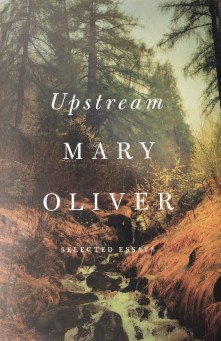
“Upstream” by Mary Oliver
Short Summary:
This collection of essays is a wonderful glimpse into the mind of Oliver, who was undoubtedly one of the greatest poets and writers of our time. Upstream is one of the last books Oliver published before her passing in 2019, yet her playful curiosity and childlike imagination seeps onto the page with every essay.
The acclaimed poet covers a variety of topics in this collection including what it means to be a creative, how to observe the natural world, and how to take advantage of the “creative and whimsical urges that live within us.” She discusses her influences and praises some of the greats; including Wordsworth, Emerson, Poe, Whitman, and Frost. On the topic of these great writers she discusses the significance of Transcendentalism and Romanticism in poetry and literature while providing generous examples of her own artistic labors.
More important than anything else, this book is a call to action. A text that provides its reader with an intriguing consideration: How far have you distanced yourself from Nature? For artists and writers, it is a reminder that looking outward is just as important as looking inward and that “Observing with Passion” is a skill obtained through practice.
Genres: Non-Fiction, Essay Writing, Autobiographical Essays/Stories
My Review:
This book exceeded my expectations in many ways. The essays delve intimately into the wondrous life of Oliver and shows the reader how she was truly enamored by Nature. If it is not clear enough in her poetry, it is made clear in these essays. What stood out to me the most were the incredible essays that discuss the influence certain writers had on her own writing. She dissects authors such as Poe, Wordsworth, Emerson, and does a close analysis of Whitman’s Song of Myself and Leaves of Grass.
This is a book about observation. This is a book about the subjects relationship with the artist. This is a book for the painter, the sculptor, the musician, the writer, and more. Oliver spans a lifetime in these pages. She talks about the childhood curiosity she had when she was younger. The huts of sticks and grass she made in the small pastoral forest near her home and how, there, she learned that “it was important to be alone; solitude was a prerequisite to being openly and joyfully susceptible and responsive to the world…” (Oliver, Wordsworth’s Mountain, 111) From her childhood to her last days, she gives the reader a glimpse into her life that they will never forget.
Oliver was known to walk nearly everyday through the Nature that surrounded her home in Provincetown, MA. Several of the essays are full of imagery from this place, and the last essay is a homage to the town itself. Place is very important to her and her writing and it is driven by her language. Poetry is found in nearly every line of this book. There is no worthy way to describe her diction, her syntax, or her tone. They are simply spectacular.
“Writing is neither vibrant life nor docile artifact but a text that would put all its money on the hope of suggestion.” – Mary Oliver, Upstream
RAAW (Reading as a Writer):
For this book I wanted to focus on her Voice. More specifically, the brief interruptions found in her essay that are separated by dashes. She is separating her clauses to emphasize something that isn’t necessary to the essay but is important for the reader to know according to her (the author). These don’t have to be there but she chooses to include them to help heighten the voice of the essay. For example,
“In creative work—creative work of all kinds—those who are the world’s working artists are not trying to help make the world go around, but forward.” – Mary Oliver, Of Power and Time
This technique provides the authors voice to come through (even more) in the body of the essay. It creates a certain intimacy and a closer look into the authors world. The reader feels it is more personal. These can also be replaced with parentheses depending on the authors stylistic choice. Often, parentheses are found in technical writing. Here is a more personal example:
“The poet Shelley believed his body would at last be the total and docile servant of his intellect if he ate nothing but leaves and fruit—and I am devoted to Shelley.” – Mary Oliver, Sister Turtle
Voice is key to a strong personal essay. When writing non-fiction, the author wants to share a unique story of their own but also create a relatable experience for the reader. Providing these brief interruptions can immerse the reader further. The tone is greatly affected by this technique as well and makes the essay seem conversational. While reading this collection, you will feel as if you are sitting in her garden listening to her tell her stories.
Some of these essays talk about writers and others are more personal, following her through the wooded areas of Massachusetts; her relationship with a female spider spinning her web, taking in a wounded gull and caring for it in her bathtub, or searching for the barred owl in the canopies around her home.
All of them have an underlying theme. Observation. As creatives, we need to look outward and learn from the world around us. Stay in touch with your senses, take a walk through the local park, or go breathe in the ocean air. We are just a part of the natural world and we shouldn’t forget that…
“The world where the owl is endlessly hungry and endlessly on the hunt is the world in which I live too. There is only one world.” – Mary Oliver, Owls
Notable Essays: Bird, Building the House, The Bright Eyes of Eleonora (Poe’s Dream) & Staying Alive

 OSCAR H. WHITE
Leave a comment