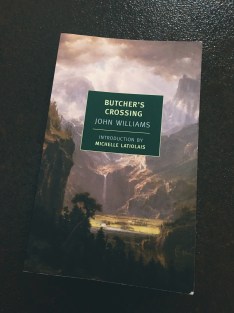
“Butcher’s Crossing” – John Williams
Short Summary:
John Edward Williams was the author several books including Augustus and Stoner. Williams often wrote historical fiction, introducing his readers to worlds built from immense research, historical texts and personal experience. Butcher’s Crossing (Published in 1960) is a novel that follows a boy name Will Andrews in the 1870’s. Andrews is a drop-out from Harvard who, after hearing a lecture from Ralph Waldo Emerson, decides to move west in search of adventure, but more importantly, self-enlightenment.
When he gets to Butcher’s Crossing, Kansas, he is swiftly taken under the wing of Miller, a hide hunter that is hoping to head west to the Colorado Territory to hunt Buffalo. Andrews accepts his place among the crew of four men and they set out, but soon his lack of experience and poor choice of company get the better of the situation. They remain in the Rocky Mountains, snowed in by a sudden blizzard, for six months. Here, they fight for their lives and their sanity, as their survival skills are put to the test.
This novel is told in the third person perspective and often has beautiful descriptions of the characters and their surroundings. It is one of the purest examples of western fiction ever written. Witty, dangerous, romantic and beautiful. This book has it all. A heartache love story veins its way throughout the text and the reader feels strung out, waiting out the bad weather with the rest of the book’s characters.
[Note: Some of the content in this book is hard to read, as it is a very accurate representation of what life was like in the Territories in the 1870’s. Examples may include: Violence, Objectification, Extensive/Descriptive Hunting, etc.]
Genre: Western Literature, Historical Fiction
My Review:
I want to first discuss the importance of this novel in regards to the Scope of Western Literature. One of the things that I, as both a writer and a reader, appreciate most about Butcher’s Crossing is its portrayal of the life and times of a young man in Late-19th century America. This was a time of “so-called” manifest and prosperity, a time where men and women had a much lower life expectancy and the value on life was minimal. What I am saying is: this book gets it. Sociologically, philosophically, economically, emotionally… this book is spectacular. It is both an examination and the deprecation of the American Dream and what it was at that time! It places the reader inside the mind of Will Andrews, who was heavily influenced by the manifestation and movements of the 1870’s. This book (the plot) is about Andrews and his companions surviving a storm, but upon deeper analysis, the reader realizes that it is so much more than this…
This is what historical fiction is all about! None of that bathetic, stereotyped, romanticized and clichéd Western Writing that you get in pop-culture now. This is one of the most accurate (to the time) period pieces I have read. This can be attributed to Williams protagonist being so relatable, especially for young readers (college aged men and women that are experiencing the political, economical, social and natural issues we are facing today).
Lets start at the beginning of this book, when we learn that Andrews has dropped out of school because he has been inspired by Ralph Waldo Emerson and his lectures. Let’s think about Emerson and what he stood for. He was one of the big contributors to what was called “Transcendental Movement” in philosophy/ art/ literature/etc. Transcendentalism is all about self-reliance, nonconformity and the unifying goodness of both humans and Nature. We (Humans) are our best-selves if and when we surrender to the ‘naturalness’ of being human and understand that naturalness’ relationship with the outside world.
“The happiest man is he who learns from nature the lesson of worship…”
These ideas send Andrew on a quest for this enlightenment. He is bent on seeing the rest of the country and the freedom that is associated with this new land. It is full of new opportunity, lawlessness, natural splendor, etc. This all excites him, and in his anxiousness, he agrees to be a part of this hide hunting team, which leads to the horrific situation of being trapped in the mountains with close to no provisions. Again, it is amazing because this book is so true to history. Williams does so much research on what it was like to live in that time as a hide hunter. All the way down to what cuts to make (And what knives to use!) when skinning or butchering certain game. As a Historical Fiction writer myself, I know how difficult this is. You have accumulated so much research on a number of different subjects, and sometimes weaving that information into the narrative is hard to do. Williams does it perfectly! All while keeping the reader engaged in the story.
The reader stays engaged for several reasons, but two that stand out are… Williams’ ability to give such vivid imagery and create such believable dialogue. Here is an example of imagery, in which Andrews rises from sleep, and looks out upon the snow that had trapped them the night before:
“When at last he was able to look around him, he viewed a world that he had not seen before. Under a cloudless sky, and glittering coldly beneath a high sun, whiteness spread as far as he could see. It lay thickly drifted about the site of their camp and lay like movement frozen, in waves and hillocks over the broad sweep of the valley” – John Williams, Butcher’s Crossing (p.183)
The last thing I want to (briefly) mention before going into the next segment is a writing technique called Dramatic Visualization. This is something that is really interesting, as it really only appears in long-form fiction. It means just what it sounds like… Creating dramatic scenes, by use of language and syntax, so that the reader can visualize clearly what is going on. Perhaps this is the topic of an entirely new blog post, but I wanted to mention it. Williams is wonderful at taking scene, setting, characters, actions, etc. and describing them with such detail that the reader never really feels lost. Williams leaves just enough for the readers imagination to interpret it in its own way. I’m trying to say that: this is one of the greatest books “Written” in terms of the novel form and the writing techniques used to story-tell.
[As novelists, we have a lot more words available to us than short story writers or poets. We need Dramatic Visualization so that the reader isn’t bored. Imagine that writing a novel is like arranging a play: you need to create everything from script to stage direction to transitions! Otherwise, the play is incomplete and does not make sense to the audience! Perhaps I will do another blog post on this later…]
RAAW (Reading as a Writer):
This review I will discuss a writing/structural technique that stems from Ancient Greek tragedies called, Hamartia. Williams uses this device to show how three of the four men are brought to ruin by a tragic flaw/error. Often these tragedies are caused by certain personality traits such as greed, arrogance, pride, inexperience, etc. Hamartia, in other words, is a tragic flaw that leads to the downfall of the story’s characters. Given the brutal and rugged circumstances that these men come to deal with, the plot allows for certain characters to reflect on what went wrong in their search for their fulfillment. Inexperience pushes Andrews toward this trip. Greed pushes Miller (the Hunt leader) to stay longer in the mountains, ultimately getting them snowed in for months. The whole idea behind a tragic story is to show the truth to certain life lessons such as theconcept that “Failure is important to endure.” This goes back to what I was discussing earlier: this book is not the romanticized western you get in John Wayne movies. This is real. Despite the book not being focused on one hero, it exploits the men and their tragic flaws… showing that despite their hardships, they may not prosper/survive.
I am afraid that I can’t go into much further detail about this device because it will spoil the book for you! But trust that Williams’ Tragic arch to his characters is amazing. Karma, Justice, Vengeance… It is all there.
This is a story about survival, exploration, love, adversity, violence and so much more! An incredibly vivid book that makes you feel as if you are there with the characters, suffering from the skin splitting cold. Sometimes horrifying, sometimes hilarious… Shades of Cormac McCarthy, Robert Olmstead, Annie Proulx, Joyce Carol Oates, and more! Historically accurate and pleasantly informative, this book is a classic. From a writing standpoint, it is one of the most sound and complete novels I have ever read, making it a top ten book on my list, that is for sure!
I will attach the link to the New York Review Books Edition Here: “Butcher’s Crossing” NYRB
Also by John E. Williams:
- “Stoner” (1965)
- “Augustus” (1972)
- “Nothing but the Night” (1948)
 OSCAR H. WHITE
Leave a comment