“Frankenstein” by Mary Shelley
or The Modern Prometheus
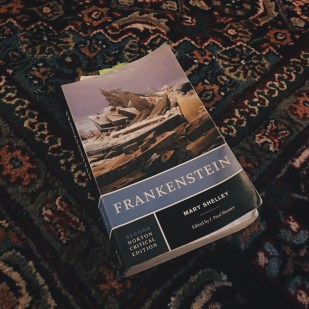
Short Summary:
The classic story of scientist Victor Frankenstein, written by one of the most ingenious female writers, Mary Shelley, in 1818. The book begins in the frame narrative, where a captain (Robert Walton) of a research ship has rescued Victor from the icy weather of the arctic. Here, on the ship, Victor begins to tell the story of his creation and ultimately his descent into madness and grief. The story of his creature, born from dark science, is one of Gothic splendor. Maddening narrative, gloomy imagery, and horrifying acts of cruelty riddle the pages.
The frame narrative leads into Victor’s account of his childhood and his time at university, where he studied Chemistry and Biology. Fixated on the re-animation of the human body, he creates his masterpiece: a mosaic of body parts described as both beautiful and terrifying. When this creature escapes his flat, it begins to haunt Victor for the remainder of his life, while Victor’s mind haunts itself due to his work’s moral implications. It is a story about love, family, loss and revenge. A man and his creation fighting for all they know, with all they have.
Although modern depictions in pop-culture may misinterpret Frankenstein, making it a story of abundant horror rather than a mournful example of humanity, it is still considered one of the greatest novels of all time. Shelley, the grandmother of science-fiction, shows us what it means to be human through this dark and twisted account. Themes and motifs include escapism/naturalism, human rights, morality, ethics, social construct, alienation, creation, obsession, science, Universal Law, etc. This book is at the heart of the Romantic Era of Literature and will remain one of the most influential stories of all time.
My Review:
This book has made such an incredible impact on my writing and could very well be my favorite story of all time. To not do a review on this novel would be ridiculous. There is so much to pull from this book, that I almost wish I could do this review in three, five, or even ten parts! I will do my best to not give away the entirety of the plot, but rather give you a solid understanding of the books themes and writing techniques.
That being said, Frankenstein is one of the most well-known and inspiring books of Gothic fiction ever written. The philosophical torment that Victor goes through and the horrific imagery Shelley provides of the creature and its actions, fuel the dark narrative into history. It is told with a frame narrative (a story that caps both ends of a main plot, allowing the reader to have multiple interpretations of themes and characters) This framed story begins on a research vessel, somewhere near the north pole. Most of the narrative is given to the reader through the epistolary form and one soon concludes that Captain Walton is fascinated by the man he has saved (Victor) and his story. While Victor recovers, he begins to tell his story (childhood to present) as a precautionary tale. He warns Walton of his greed and asks him to listen to his advice.
What follows is nothing short of imaginative genius. Victor describes his obsession with his work and the pain that obsession causes to his closest friends and family. The language that Shelley uses is simply fantastic. She is hyper-aware of the socio-linguistics and jargon used by both scientists and people of Western Europe in the early 19th century. This writing, paired with the imagery of Victor’s flat, Lake Geneva, and the mountainous Swiss countryside is spectacular. These images of natural beauty are shadowed by the inhuman, barbaric, and unnatural world of the creature.
Harm comes to Victor when his creature escapes and begins to torture him with his relentless stalking and acts of cruelty. To protect his family, and the woman he loves (Elizabeth), Victor vows to hunt and kill his creation. But… things don’t work out and he falls ill, allowing the creature to do as he pleases. This was the hardest part of the book to read, only because Shelley spends a lot of time showing the grief, pain and sickness of Victor. At one point you may wonder, Dude… Don’t you have work to do? Get up from that bed…
But! The story changes when Doctor Frankenstein meets his creation and allows the creature to share with him his story: a story of heartbreak and loneliness. One that surprises the reader into what some call Sympathetic Imagination. Although this is a book I have read several times, I have not yet read this for my graduate program. Still, I am choosing to do a RAAW segment on this topic anyway…
RAAW (Reading as a Writer):
There is one thing that I take away from this book more than anything. (And when I say “take away,” I mean as a writer in terms technique, structure, etc.) Shelley is able to accomplish something very few writers (Even now!) have been able to do: make the reader feel sympathy for a character that is a tried-and-true representation of evil. The creature is given the chance to tell his own story. How and why he believes he was created. In this brief section of the book, Shelley accomplishes this feat by giving the creature feeling, compassion, and hope for humanity. He shows fear and love, anger and sorrow. The creature talks about his lack of maternal/paternal care and his isolation from society, forced upon him by the greed of Victor’s work. We are supposed to despise this character, and for the first 2/3 of the book, we do. But the creature’s poetic, and genius, monologue allows the reader to access what we call sympathetic imagination. We imagine ourselves as this creature, placing ourselves in his shoes (or lack there of) and are able to access those emotions; pain, suffering, alienation, loss, etc.
This is one of the greatest antagonists in literary history. He is a symbol of evil, sin, darkness and violence. Yet, Shelley shows us that he is articulate and kind, capable of love and creativity. The creature pleads that he is a living being and should be given free-will, joy, and hope (as well as a female companion, created by Victor). The breaking of this “wall” is not easily accomplished, but Shelley gives an incredibly detailed account of everything the creature had been through up until their meeting, and this seems to nearly justify his acts of cruelty, which can only be accredited to this amazing example of sympathetic imagination.
“I am an unfortunate and deserted creature; I look around, and I have no relation or friend upon earth. I am full of fears; for if I fail there, I am an outcast in the world forever.” (Shelley 93).
The story continues and we see more themes. One in particular is the idea of Escapism. The desire of one to take a step beyond the constricting societal boundaries and return, if only for a moment, to the natural world/way of living. Escapism incorporates both external and internal relationships with Nature and what it means to be Human. For authors, poets, and artists of the Romantic Era, it often aided the journey of self-discovery. The story has many examples where Shelley compares the characters to the landscapes that surround them. She also shows the contrasts between society and the natural world by often secluding her characters from humanity. Though the main example of this comes during the creatures story, we see it with Victor and Walton as well.
Following the creature’s narrative, the story continues with Victor and ultimately ends with Captain Walton once more. The rest… you will just have to read for yourself. I could go on and on about her writing (diction, form, dialogue, motifs, retrospection, etc.) and the story (themes, outcomes, characters, relationships, etc.)
But I will conclude with this:
Although some may find it hard to read, this Gothic/Science Fiction story is one of the greatest ever written. Shelley endured several hardships during publication because of her gender, age, and marriage to Percy B. Shelley. It was first published anonymously, only with a dedication to her father, William Godwin, and introduction by her husband. Only later was she capable of publishing it with her name. This was a time that female writers were not allowed to publish in most forms and were even told not to read or write at all. Being the creative genius she was, her work made ripples in the literary community even then, and she proved to the artistic world that women did have a place in popular culture, science, politics, arts, etc. A truly amazing life and story of her own!
A book of both beauty and terror. A must-read if you are a fan of philosophical literature, Gothic literature, science fiction, or just wonderful writing. Also, if you are interested, I will post the link to the Norton Edition of the book below. This has a new preface, several critiques and annotations, and essays accompanying the original text. (Wonderful for students)
(Fans of Poe, Giono, Stoker, Alighieri, Milton, Melville, and Lovecraft will enjoy this book!)
 OSCAR H. WHITE
Leave a comment