“A King Alone” by Jean Giono
“Un Roi sans divertissements est un homme plein de misères” (A King without diversion is a man full of wretchedness)
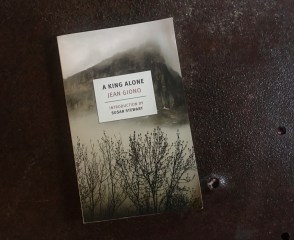
Short Summary:
This story, written by Jean Giono and translated from french by Alyson Waters, is a masterfully crafted account of a small village in the French Alps that is being terrorized by a silent murderer in 1843. Told from the perspective of the town and several of its inhabitants, the reader is handed a frightening story that proves that humans are truly capable of evil.
Giono provides a vivid image of the French Alps during the lonely winter months and creates an atmospheric doom with a mastery of motifs, stark descriptions and sensory details. The story is meant for the reader to interpret in their own way and often asks the reader to solve the mysteries with the characters it involves.
The village is tucked amongst several large peaks that isolate the townspeople during the winter. In 1843, people begin to disappear. Police captain and soldier Langlois is hired to come search for the man that has been terrorizing the town. The killer is only referred to as Monsieur V. The investigation is long but calculated and when Langlois returns years later, the villagers had not forgotten him or the winter of ’43. Only now, he is hired by a royal prosecutor to hunt wolves that roam the thick forests surrounding the village.
The novel contains several philosophical arguments in ethics and existentialism. It is a study of why people commit such crimes and the recognition that evil is seeded in every human. For some of the characters in the novel, the loneliness and desolation of existence can only be alleviated by said violence. This is a riveting book full of dark cabins, quiet woods and fascinating characters.
My Review:
This is one of my all-time favorite books. Jean Giono’s ability to depict isolation, fear and mystery is second to none. The translated text is passed on beautifully by Alyson Waters, and despite Giono’s sophisticated diction/vernacular, the book captures you right away. You feel as if you are right there with the characters, just as involved in the investigation as they are. This can be attributed to Giono’s unique choice of perspective. The point of view shifts in the book several times. Examples include: First person, first person plural, third person omniscient, etc. I read it as if the town was telling the story. Sometimes Giono is “all-seeing” where the reader is provided a large overview of the town and its surrounding wilderness. Other times, it zooms in on moments of peculiar intimacy. In Susan Stewart’s introduction, she writes:
“[The Novel] is assembled from the words of a narrator who is recounting layers of reported speech… [similar to] the game we call in English [“Telephone”]: repetitions inevitably resulting in distortions that open to the wishes and fantasies of even the most certain and rational of speakers.” (Stewart viii)
This may sound concerning but do not worry, I never once felt lost or bored with the narrative. The story is so incredibly tense and vivid that the point of view easily drifts to the back of your mind when you are reading. Though, when you think about Giono’s storytelling ability and his choices as a writer, the perspective is genius.
The setting is certainly a character in this novel. Giono uses vivid imagery to describe the cold, colorless land. This immerses you, making you feel the presence of nature constantly, even in scenes driven by dialogue or distant narrative. The mountains control what the people do. If there is a blizzard, they remain inside, huddled in their homes. If there is sunlight, they emerge from their sanctuaries and go to work or church. This haunting landscape allows the antagonist to walk freely amongst people’s homes, lurking in the shadows or in the quiet woods.
“Outside there is no longer earth nor sky, neither village nor mountain; nothing but a crumbling heap of thick, frozen dust from a world that must have exploded.” (Giono 11)
I want to briefly discuss how a reader should interpret stories. That is, the reader should consider what the author includes or excludes from the narrative because it may just change your analysis. The book is considered a mystery, but strays from the classic mystery plot (which may be frustrating for some readers) The narrator does not spend time on the motives behind the murders but instead focuses on the impact that the murders have on other characters. Leaving out this aspect of a murder mystery makes the reader examine Langlois and other characters. How do they handle fear? Does fear change their view of the world? Do they let their mistakes or triumphs define them? The book is not attempting to define evil, but instead considers the effects of evil on the human psyche. In my opinion, Giono wants his readers to look at the universal philosophies the book raises, rather than placing one example of evil under a microscope…
RAAW (Reading as a Writer):
For this novel, I chose to discuss motif. There are several recurring images in this book. A large beech tree that looms over the town, dipping its branches upwards into the thick blanketing fog. The candlelit windows and oil street lamps. OR blood on fresh snow. A motif is a decision made by the author and often the image is symbolic of relationships, character development, overarching themes, etc. The image of blood in the snow represents the vulnerability of the village and the murderers ability to disrupt its purity. Giono stresses the isolation and the peace of the town a lot in the beginning of the book, which makes the spontaneous murders more frightening for the characters. (More simply put: Blood = Violence, Snow = innocence)
“Bergues came back empty-handed. He’d followed tracks, bloody ones. The man had been wounded. There were drops of blood, very fresh, pure on the snow…” (Giono 16)
Later on in the novel, Langlois is captivated by the blood of a goose. He stands in an open field staring at the place where the animal had been butchered. Here, the symbolism of the motif is more philosophical for Giono. Langlois realizes that Monsieur V was much like him, or any other man, and Langlois understands that he too is capable of evil.
In conclusion, the book is an immaculate mystery that feels as if the reader is floating in and out of a dream. Disturbing and raw. Beautiful chaos. It is a page turner that keeps you right on the edge of your seat. I read it in two or three days, though the copy I have (The New York Review Book Classic Edition) is only a 155 pages. I will include a link for it via amazon below!
(Fans of Shelley, Stoker, Kafka, Nietzsche and/or Poe would enjoy Giono’s writing!)
“A King Alone” – Jean Giono, NYRB Classics. (Amazon)
More by Giono:
“The Man Who Planted Trees” – (1953)
“Melville: A Novel” – (1941)
“The Song of the World” – (1934)
 OSCAR H. WHITE
Leave a comment