“Blood Meridian” by Cormac McCarthy
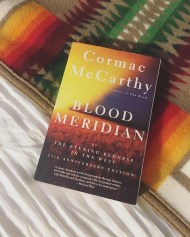
Short Summary:
This novel was first published in 1985 by McCarthy, who is arguably one of the greatest American writers of our time. He is the master of bleak landscape, tortured protagonists and scarce dialogue. Blood Meridian exemplifies all of these techniques and shows the raw and uncut side of the American West. Set in the 1850’s along the Texas-Mexico border, the story follows a fourteen year-old kid who finds himself caught up with a misfit posse of outlaws who are hired by the state to collect scalps.
While patrolling the borderlands, the men start to inflict and endure horrible acts of war and violence. The desert itself becomes their enemy and survival becomes crucial at several points in the book. Ex: dehydration, hallucination, wolves, etc. The main conflict comes within The Kid, as he struggles to define the morality of his decisions. The Kid’s sympathetic awareness (often mistaken by the other men as his youth) is a point for conflict among the men, especially Judge Holden. The twisted hierarchy of the posse is put to the test as McCarthy delivers yet another ruthless and graphic story.
(The group of men is based on the real Glanton Gang and has many historically accurate characters, including Glanton himself. Although, the Protagonist (The Kid) and the Antagonist (Judge Holden) are fictionalized.)
My Review:
The story is a literary epic, designed for the reader to endure the journey alongside the hero ( or anti-hero) that it follows. The plot, though seemingly aimless, is thoroughly calculated and arranged completely for the reader. The mastery and genius of McCarthy’s writing is shown through his vivid description of landscape, unflinching violence and sparse dialogue. It seems, at times, that you are reading a lengthy poem designed to lose the reader in diction. Example,
“They saw half buried skeletons of mules with the bones so white and polished they seemed incandescent even in that blazing heat and they saw panniers and pack saddles and the bones of men and they saw a mule entire, the dried and blackened carcass hard as iron. They rode on.” (McCarthy 48)
The book contradicts what the American Western is all about. It does not abide by the tropes found in the genre and certainly does not romanticize anything about frontier life. (If you want a western that leaves you wide-eyed and wanting to ride off into the Moab, read Jack Schaeffer’s novel Shane. Another amazing book) Although the idea of manifest destiny is evident in the story; the reader can expect a violent, drunken, maddening, behind-the-scenes interpretation of it.
If you are a fan of Philosophy, specifically Existential Nihilism, please read this book! Existential Nihilism deals with the value of life. The book asks: what is the significance of one human relative to earth’s existence? What is the purpose of a character or that character’s actions? The book also takes a complex look at morality. There are multiple character studies dealing with this, the most important being those of The Judge and The Kid. These characters are violent and have scarce emotions on the page and their actions leave the reader asking so many questions. Questions regarding a variety of subjects: Good and evil, moral reasoning, metaphysics, the purpose of our existence, etc. This is not meant to scare people away from this book. It should make it more attractive, but that’s me. (You could lure me into a cage with a good philosophy book) To expand on this, I want to reiterate the point I made earlier: this book is very maddening! There are times when a character will question the nature of reality, which in turn will make you question it as well. Let it happen… it’s cool.
This book was one of the first I read for my MFA. My program asks me to read three to four books a month and write critical response papers of these texts. My reviews (in the future) will have a small paragraph about what my topic was and why I chose it. This is what my peers call “Reading as a Writer,” Or as I like to call it: RAAW!!
RAAW: For this novel, I chose to write about how Cormac McCarthy uses sociolinguistics to differentiate characters. In other words, I decided to look at the factors that drove certain dialects. For example: Region, Occupation, level of education, etc. I chose this topic for my essay because of how impressed I was at McCarthy’s ability to have multiple characters in scene without confusion. The without confusion aspect is crucial. Why? Because Cormac McCarthy doesn’t use quotation marks and often does not use dialogue tags (he said/she said)… I’m not kidding. Pick up any McCarthy book and you will only see indents indicating the beginning of his dialogue. The reader is able to follow these conversations because he is able to create such distinct voices between his characters. For example, Judge Holden is a man of incredible intellect and is often contrasted with men without such vernacular. I could turn to any page of this book and pick out Judge Holden’s words by the vocabulary McCarthy uses. Pretty amazing.
McCarthy has always been one of my favorite writers because of his dialogue (something that I have struggled with for years/continue to struggle with today) If a writer is having a hard time writing dialogue, I suggest reading Blood Meridian or No Country for Old Men. There are three things that a writer should consider when approaching dialogue: (1) Making it sound natural, (2) furthering character development and (3) creating tension. McCarthy can use his dialogue to his advantage anytime/anywhere, and that is a technique that every writer should want to have in his/her arsenal.
Overall, pick up this book if you are interested in a gritty, delirious, bloody western! Outside of the literary and compositional value of it, it is a wonderful story about what it means to be human and how meaningless war/violence is. But, if you are looking to dissect a book and pull out its artistic insides, you REALLY should pick up this book. It will leave you with so many questions (that I would love to discuss with whoever) just because it can be confusing! But more importantly, it raises questions about a lot of significant themes such as sexuality, race, religion, philosophy and more.
Note: This book can be incredibly hard to read at times and has many events and descriptions that can be triggering and traumatic to some readers.
Accolades: Despite its lack of reception in the late 20th century, Blood Meridian is now known to be McCarthy’s best work. TIME Magazine included it in the “100 Best English-language Novels from 1923-2005.” TIME Mag
(Fans of Faulkner, Hemmingway, O’Connor, Olmstead or any gothic writer will enjoy McCarthy’s writing)
More by McCarthy:
– “No Country for Old Men” (2005)
– “All the Pretty Horses” (1992)
– “The Road” (2006)
– “Suttree” (1979)
 OSCAR H. WHITE